by: Jazmine Sachiko Ross


The story, roughly.
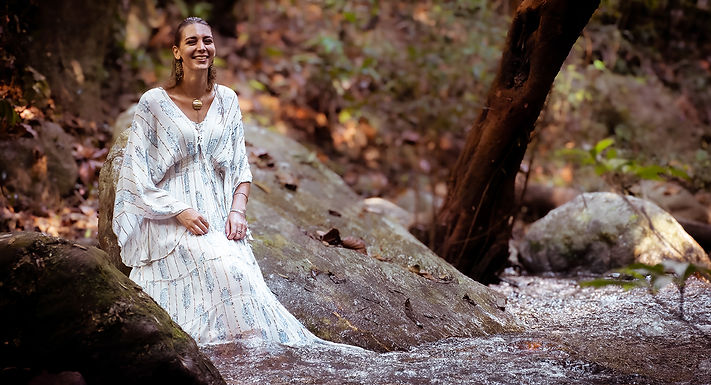

There's a specific kind of exhaustion that doesn't show on the outside.
You're functioning. You might even look, from a distance, like you have it together.
The career is real. The capability is real. The self-awareness, in many ways, is real.
And still. Something underneath is quietly, persistently tired.
Not burned out in the dramatic sense. Just... the cup never quite fills. The achievements don't land the way you thought they would.
The work you've done on yourself is genuine, and somehow the same patterns keep returning. The same voice. The same low hum of not-quite-enough.
If you recognise that feeling, I see you.
I grew up as the eldest daughter of the only Caucasian family in a tiny fishing town on the Noto Peninsula, it's no exaggeration to say it's one of the most rural parts of Japan.
Visible from the moment I stepped outside. Shaped by two languages, two cultures, and two entirely different maps for understanding what it means to be a person in the world, and belonging fully to neither.
I had no mirrors. No one who lived between the same worlds I did. Every framework I built for understanding myself, I built alone, which meant they were always provisional hypotheses, never inherited certainties.
What that produced, over time, was a particular kind of mind. One that questions what it's been given. One that can hold contradiction without collapsing. One that is, by necessity, deeply curious about what is actually true versus what has simply been handed down.
It also produced something harder to name.
I was fluent in reading rooms but illiterate in reading myself.
I grew up in two languages, neither of which gave me a complete emotional vocabulary.
Japanese offered sensation: moyamoya, the feeling of something unresolved sitting in your chest like smoke. English offered categories: sad, anxious, or fine. Neither gave me the full picture.
And before the languages, before any of that, I had learned, very early, to read other people's emotional worlds before my own. To locate myself by locating others first. To make myself small enough, or large enough, or whatever was needed in the room, in the family, in the culture, before I'd ever been taught that my own interior was worth attending to.
I didn't know this was happening. That's the thing about conditioning.
It doesn't announce itself. It just becomes the water you swim in.
For years I did what the self-development world suggested.
I found myself. I worked on myself. I built things and rebuilt them.
The turning point came in 2020, long before I had words for any of this. A single email cracked me open with a physical reaction so strong that I signed up for therapy that same day.
In the first session, when the therapist asked me what I was feeling, all I could say was "I'm stressed."
She handed me a wheel of emotions. A map of the interior that nobody had ever given me before. And sitting there, looking at all of those words, at the entire landscape of human feeling that I had been navigating without language, I understood something I hadn't been able to see before.
I didn't know how to find myself in my own emotional world. Not properly. Not with any precision.
I could sense something happening inside, but I wouldn't let myself actually feel it. If I did feel something, I deduced quickly whether it was “appropriate” or not and usually cut it off before it could land. And without feeling it, I couldn't locate where it lived in my body or what it was trying to tell me. That gap was at the root of everything.
The patterns that kept returning, the cup that wouldn't fill, the sense that I was doing all the right things and still somehow missing something fundamental.
You can't navigate what you won't let yourself feel
. You can't work with a signal you keep cutting off.
Two years later, in 2022, I went viral. Seven million people watched a story I told about growing up between worlds.
And I felt like a fraud.
People complimented my composure. My clarity. How well I could articulate the experience of living between cultures. But I had only shown them the outside. The visible part. The part I could explain.
The reality was that I had already sold everything, left my entire life, and was living out of a car and a tent with no plan.
The opposite of composed.
I was throwing myself into the deep end, facing solitude, dismantling every structure that had been holding my life together, hoping that if I stripped everything away I could finally find what I'd been missing.
I couldn't talk about that. I was still making sense of it myself.
So I stepped back from the attention. I travelled. I worked with people all over the world. I got certified as a coach. And slowly, through years of holding space for others navigating their own gaps between feeling and language, I started finding words for my own.
English gave me precision for naming emotions. Japanese gave me containers for the practices that actually help you work with them. Ma, the sacred pause. Arinomama, as you are. Go-en, the strength of connection and alignment.
The work wasn't about the language itself. It was about learning to actually feel what I had to feel so that I could better understand the signals from my inner world.
I have the gift of two languages to find the words that describe it them accurately.
Sometimes that was English. Sometimes it was Japanese. Sometimes it was both.
In 2024, a massive earthquake devastated the Noto Peninsula. The town I had left at eighteen and never truly looked back on was fundamentally changed. In 2025, I returned. The childhood home I'd grown up in was gone.
What I found there wasn't a breakthrough. It was a confirmation.
The people who had watched me grow up, classmates' parents, neighbours, people I hadn't seen in decades, didn't see a foreigner. Didn't see someone who didn't belong. They said: kaetta ne. She's returned.
I had spent my whole life deciding I was locked out. And the town had just been waiting.
I was Wajimanoko, a child of Wajima, all along. I just couldn't feel it underneath all the performing.
Standing in that place, steadier than I had ever been, without the house and without the version of myself I'd left behind, I understood what the years of work had been building toward:
The belonging had always been there.
I was the one who couldn't receive it.
That is arinomama.
Not a concept I learned. A homecoming to something I had always been.
And the particular gift I carry, the thing I didn't choose but was shaped by, is this:
I can sit between East and West and see what each side needs from the other.
The emotional precision English offers. The practice containers Japanese provides.
The answers that exist in both but get lost when they stay in only one.
That's what I bring now.
Here's what I know now, from the other side of all of that:
The exhaustion most people carry is not a personal failing.
It is the entirely predictable result of living by standards that were never yours.
Performing worthiness for an audience that never asked for the performance.
Spending enormous energy filling a cup with the wrong thing.
The self-development industry offers a solution: become better. Try harder. Grow more.
But if you start from the premise that you are not enough yet, every improvement just confirms the original belief.
The cup never fills. Because the problem was never your performance. It was the premise.
The work I do starts from a different place entirely.
Not self-improvement. Self-return.
Not becoming someone new. Remembering someone real.
Not fixing yourself into worthiness. Starting from it.
I use three Japanese concepts: Ma, Arinomama, Go-en. Not because they are trending, but because they are the lived language of the culture that shaped me. Because they map aspects of human experience that English doesn't have clean words for.
Because they were, for me, not tools I learned but a homecoming I needed.
And because I believe, with everything I've found on the other side of thirty years of searching, that the most radical thing available to most people right now is not another framework for becoming.
It's permission to stop running from yourself.
That's what I'm here for.
Jazmine is a cultural facilitator and the founder of Sachi. She grew up in rural Japan, holds a UK passport, and is currently based in Chiang Mai, Thailand. She works with people who are ready to stop earning their own acceptance and start living from it.
→ Start here: [From Shoulds to Autonomy — Workbook Bundle]
→ Say hello: from the form below